

It's official: the internet decided that 2026 is the year of non-toxic activewear. According to Google Trends, the term "vintage activewear" rose in search by over 10,000% this year. People are reminiscing on the days we all took for granted — when most of our clothes made out of cotton! That being said, you're probably looking at your own closet and wondering whether now's the time to make the switch.
And if you're anything like me, you might be apprehensive to the idea of cotton activewear. As someone who's also been loyal to her (mostly polyester-based) activewear sets, the idea of wearing cotton pieces on my next trip to the gym wasn't exactly appealing. But in a TikTok-made-me-do-it split decision, I finally decided to try out a few cotton options to see if they're really worth the hype.
To help anyone else wondering whether to revamp their athleisure collection, I tested out options from Old Navy, Target and Vuori to find out which ones held up best during high- and low-impact workouts. Plus, I consulted textile experts about everything you really need to know about cotton and polyester activewear.
 Best bottoms for low-impact$undefined$30.00
 Best top for high-impact$undefined$25.00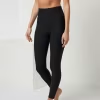


What fabrics are best for exercising in?
When it comes to selecting the best material to wear during a workout, Sean Cormier, chair of the textile development and marketing program of the Fashion Institute of Technology, says the fabric you choose really just depends on the intensity of the type of exercise you're doing.
"The key things you want are moisture-wicking, breathability, stretchability and durability,” he says.
Lisa Chapman, director of doctoral programs at the Wilson College of Textiles at North Carolina State, says cotton is an "ideal type of fabric" because "we usually want more compression, something that fits much closer, much tighter to the body that stays in place" and cotton can provide that.
"They’re breathable, they’re not irritating," she says of the material. "And they can have some really good moisture management properties, as well. But I think in particular [when] we compare cotton to synthetics, synthetics are going to give you potential lower costs but they also hold on to smells or odors.”
Cormier makes note of the benefits of polyester options, too: “Polyester is the most common workout fabric; lightweight, moisture-wicking, quick-drying. Polyester is thought by many to be uncomfortable in the summer as it is hydrophobic [water-repellant], that is true, but today’s polyester is engineered in a way that makes it more comfortable.”
“People might think they want cotton as it is natural and absorbs moisture. But that sweat can get heavy, and as it stays wet it often feels clammy,” notes Cormier.
How I tested cotton and polyester activewear
I wore a tank top and a pair of leggings in both cotton and polyester during high- and low-impact workouts. For my low-impact exercises, I did 15 minutes of gentle yoga and went on a 30-minute walk. The high-impact workouts consisted of a 15-minute weighted exercise and a 30-minute run.
Throughout each session, I made note of how comfortable the fabrics were and how much odor and sweat they retained by the end.
Best fabric for low-impact workouts, according to the author
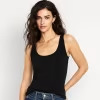
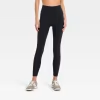
When it came to doing low-impact workouts, having a fabric that felt cozy and breathable was exactly what I needed, which is why I would opt for a cotton set when doing lighter exercises.

This top offered immense comfort and felt soft to the touch on my body. It's an airy piece that made my yoga workout and walk feel extra relaxing. I will note that, unlike other more compressing workout tops, this one won't support you on its own. I paired mine with a workout bra in order to exercise comfortably.
While I preferred this for the low-impact workout, I found that it also worked well for my high-impact workouts, too! Its lightness allowed me to get my workouts done without feeling too sweaty, and the top didn't retain much odor afterwards.


These leggings completely caught me by surprise, and in the best way possible. Despite their nearly 100% cotton composition, these felt incredibly light, stretchy and as durable as other leggings I've used in the past.
When doing the low-impact workouts, I liked how well these leggings molded to my body. During the yoga exercise, I didn't feel at all like I was being squeezed by them, which was something I noticed with the polyester option. Instead, they fit comfortably and allowed me to do my workout with ease.

Best fabric for high-impact workouts
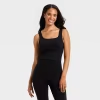
For my high-impact workout, I found polyester to be more comfortable. These two pieces offered me ample support, dried quickly and were snug in all of the right places.

This top is simple, sculpting and best of all — comes with a built-in bra. While it fared well throughout the yoga and walking exercises, the high-impact workouts were where this top truly shined. It kept me feeling supported throughout my variety of weighted exercises, along with a 3.5-mile run.
I wouldn't rule out cotton options entirely here, but this top blew me away and far exceeded my expectations. And for just under $30, it was a definite winner for me in the high-impact category.


The Vuori Clean Elevation leggings were my polyester pick and they came with incredible quality. While I normally prefer to do high-intensity workouts like these in shorts, these leggings actually stayed cool throughout the exercises, which was something I found the cotton options to lack.
While these were the more comfortable pick for a higher-impact workout, the odor retention from these in comparison to the cotton leggings was higher. However, they dried faster and offered more support overall, so I found them to be the better pick in this case.

Frequently asked questions
Whether you're looking for cotton or polyester, your preferred fabric should have the highest percentage in the blend.
If you prefer polyester, Comier says, "A blend of 60% polyester 38% cotton and 2% Lycra would be a good choice."
If you prefer cotton, Chapman says, "The higher percentage, the more benefit they’re going to have from cotton, but I would say 60% cotton or higher."
"It‘s a very durable fiber," says Chapman. "It’s going to have really good performance and durability in terms of garment washing."
She adds that cotton is thought of as being a breathable, natural fiber that's more environmentally-friendly. "It certainly doesn’t hold onto the odors or smells like synthetics do."
Meet the experts
At Shop TODAY, our reporters interview a range of qualified sources and experts to capture a wide scope of perspectives on blow-dry brushes and hair tools. We also make sure that all expert guidance and recommendations are made independently and with no undisclosed financial conflicts of interest.
- Lisa Chapman is the director of doctoral programs at the Wilson College of Textiles at North Carolina State University, where she also serves as a professor teaching courses about surface design, textures and knitting product development.
- Sean Cormier is the chair at the textile development and marketing program at the Fashion Institute of Technology where he is also an associate professor of textiles.
Why trust Shop TODAY?
Yanel Siqueiros has been a Shop TODAY editorial intern since 2025, covering and reviewing a diverse array of products and deals for their audiences. She has rigorously gone through a plethora of activewear sets since her dance days.


