

After months of blotchy, itchy and painful skin rashes, I reluctantly booked a dermatologist appointment in early spring 2025 for skin bumps that had been appearing under my nose periodically my whole life. The doctor got so far as "Hi, how are you?" before she stopped and said, "Oh, you poor thing, that's perioral dermatitis (POD)."
It was my quickest appointment ever. I was in the room for all of two minutes, then she sent me home with two prescriptions (one topical and one oral), and I thought this issue would be gone in a couple of days ... wrong! I took the antibiotics (doxycycline) and used the topical cream they recommended, but the issue still persisted, and there I was in November of 2025, just as itchy, blotchy and embarrassed by my face.
I decided it was finally time to dig deep and find something that worked for me. I was already an avid reader of the Reddit r/POD and found comfort that this was an issue that many have dealt with (even celebrities have opened up about their experiences with it). I started looking through what everyone else was using and weeding out products I knew would irritate my skin more to find out what I should try. And of course, I consulted a few dermatologists to help me break down what causes POD and how to treat it.
Keep reading to hear more about POD from experts and learn what routine worked for me!
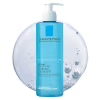 For cleansing$undefined$19.99
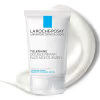 For moisturizing$undefined$24.99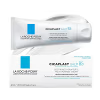


What is perioral dermatitis?
While I define POD as an itchy, annoying rash, I know that the qualified experts who see this skin condition daily can better speak on what causes it and how to spot it. Dr. Dara Spearman is a board-certified dermatologist and spoke with me about the condition. She defines it as" an inflammatory skin condition that usually is present around the mouth, but lesions can also be found around the nose and/or eyes. The rash is composed of small, red bumps. It is more common in women than men and typically is found in adults, but I have certainly diagnosed it in children. To some, POD can look similar to acne or rosacea and is often treated as these conditions."
Dr. Marisa Garshick, who is a dermatologist at MDCS Dermatology, says that POD, " is often thought of as a combination of acne, rosacea and eczema all combined together and is known to be persistent and sometimes acne-like, but it usually doesn’t respond to traditional acne treatments."
If you are dealing with POD, you most likely feel an itchy, flaky or burning sensation around these bumps, according to Spearman. She also notes that some patients don't feel anything and probably don't even know they have it. Garshick also says that your skin might feel tight or dry when the area is more reactive.
My experience with perioral dermatitis and what products worked for me
I’m a creature of habit when it comes to skin care. If it works for me, I don’t like to change it. So when my POD flare-ups started getting unbearable, I knew I had to change everything. I stopped using certain sunscreens, I stopped putting Aquaphor on it (I found out this was actually very bad for it) and I got rid of my current toothpaste because I heard that fluoride can cause flare-ups and make it worse. Then I made a list of products from the Reddit recommendations to try.

For reference, my POD is mainly around my nostrils and nose and gets worse when I am stressed, it is hot or cold or if I am sweating. My baseline for skin is that I have very sensitive skin that is often dry, and I do not have acne or rosacea. Since my POD was all around my nose, I found myself itching and touching my face often to help soothe the irritation.
My perioral dermatitis treatment favorites:
To start, I threw out my old toothpaste and began using a fluoride-free toothpaste from the brand Suri. I stopped using all of my exfoliants and toners and started to really look at ingredients to see what would soothe my skin. I also stopped using the prescribed medications from my derm (with her permission) since they did not seem to be working. Once I got rid of what I knew was bad for my skin, I started to buy products based on Reddit reviews that were similar to my flare-ups, and from brands I knew worked with my skin based on ingredients I knew were good for POD (see further down).

Because I have sensitive skin already, I know that La Roche-Posay is a brand that my skin likes. I bought this cleanser because of the ceramides in it and because it was advertised as gentle. I am a night showerer so I started to brush my teeth before my showers (making sure there was no leftover toothpaste on my face) and then I would use this cleanser in the shower on my face. I used a pea-sized amount and would rub it into my face, focusing on my T-zone area.


After getting out of the shower, I would gently pat my face dry with a towel, and then I would grab this moisturizer that also has POD-friendly ceramides and niacinamide. I used about a pea-sized amount of this and made sure to cover my entire face.

If my skin felt particularly dry or I felt like it was not moisturized enough, I would use one pump of this peptide-rich Kate Somerville cream that feels super hydrating. A little goes a long way with this one, so I made sure not to overdo it.

If my POD areas were enflamed or particularly itchy, I would rub in this balm in the areas that were bothering me. It is developed to be gentle on sensitive skin and I had seen a lot of people on the POD Reddit liked it for their flare-ups.

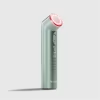
I first discovered red light therapy about a year ago when I was looking to treat my sunburns. I found it helped reduce the redness and inflammation. I had also used blue light for acne before and found that helpful. When I started to take my POD seriously and made all these changes, I did a deep dive on red light therapy for reducing the symptoms of POD (itchiness, pain, etc.) and decided to try it out.
In conjunction with my skin care, I would use this all over my face and particularly focus on my nose and areas where my POD is. When I wake up the next day, it is significantly less enflamed and irritated. I was really shocked when I first started using this because of how fast it made a difference. The small wand was great for getting deep into those POD areas.


While I spot treat my POD with my red light therapy wand, I also use this mask twice a week for 10 minutes. I find it does a great job of calming my skin and getting rid of any inflammation that I might have missed with the wand.

In the morning, I stopped using moisturizer to my face and instead went with a moisturizing sunscreen that helped reduce my inflamed skin. This one I discovered after getting a facial, and I loved how light it felt and how it visibly reduced my redness. It didn't make my skin oily, and I felt like I was wearing nothing.
My bottom line
If I could give you any advice from my struggle, it would be, don’t expect a miracle, but also don’t give up. Just like our lives, our skin goes through rough periods of anger and frustration with us. Take the time to experiment and figure out what works for you (keyword here because everyone’s skin is different). Change things up, make crazy assumptions and don’t get discouraged; there is a whole community of people out there who are doing the same as you to find what works.

It took me years to nail down what worked for me, and when life gets stressful, or my skin gets too dry, I know what to whip up to get it back down to normal. And if I can say anything about the embarrassment felt with having skin issues, it’s that no one is ever looking at your face as much as you are — so laugh, smile and keep showing face. And always consult a dermatologist with any questions — they know best!
What causes and irritates perioral dermatitis, according to derms?
Figuring out the cause of POD can be a mystery, and in my search on Reddit, many commenters said they traced it back to toothpaste or dental work. I asked the dermatologists I spoke with about this idea and Dr. Geon-Young, the founder of Dr. G Skincare, says, "Both fluoride and stress are recognized triggers. In fact, many patients improve after switching to non-fluoride toothpaste. But there are other common culprits too: prolonged use of topical corticosteroids, overuse of skin care or cosmetics, psychological stress and hormonal fluctuations, and irritant surfactants (e.g., sodium lauryl sulfate)." Garshick also says that overuse of skin care products like exfoliants and retinoids can also cause the condition.
Spearman agrees that toothpaste with fluoride can cause POD, but also says, "Oftentimes, there is not just one cause but several factors contributing to the condition. In many patients, I see POD triggered or worsened by steroid creams. This is because the steroid actually causes irritation as well as disrupts the skin barrier function."
All dermatologists say you should refrain from using topical steroids, and Geon-Young mentions to avoid products with ingredients like “Topical corticosteroid creams, fragrances and essential oils, alcohol, SLS/SLES (sodium lauryl sulfate/sodium laureth sulfate) and heavy occlusive oils (e.g., mineral oil, petrolatum).”
How to treat perioral dermatitis, according to derms
A remedy I came across quite often with POD was something called "zero therapy," where you basically stop all skin care for a week to give your skin a break. The dermatologists I spoke with said that the process can be beneficial because it allows your skin to breathe and repair its barrier. Garshick says, "It doesn’t work for everyone, and going completely without moisturizer may worsen dryness or discomfort. Generally, it is recommended to simplify a skin care routine, only using gentle essentials like cleanser and moisturizer."
For treating POD with products, Geon-Young says to look for products with ingredients like:
- Centella Asiatica extract → helps reduce inflammation and promotes wound healing
- Panthenol → provides intense hydration and soothing effects
- Hyaluronic acid → delivers moisture to the skin
- Ceramides, niacinamide, zinc and similar barrier-supporting agents
The dermatologists stressed using simple ingredients that focus on soothing the skin and repairing the barrier. Garshick says "avoid any harsh toners or scrubs, which can be irritating to the skin." Spearman says, "I often recommend avoiding makeup or even heavy or scented skin care products until after the POD is clear. Additionally, I recommend using fluoride-free toothpaste at least for the short-term, as well as avoiding cinnamon-based food, including chewing gum, which can be a sneaky trigger that prevents response to treatment."
When it comes to red light therapy, Spearman says, "Red light therapy is great for reducing inflammation and redness. It can also speed up healing and calm the skin."
More dermatologist-approved perioral dermatitis treatment products

For moisturizers, Garshick shares to opt, "for gentle, fragrance-free moisturizers that won’t clog the pores. This pick from Garshick is powered by hyaluronic acid and niacinamide.

I use Vanicream for my body lotion and love how thick and moisturizing it is. Garshick recommends this one and it has many hydrating elements to it like ceramides.

Garshick also recommends this moisturizer because it won't clog your pores and hydrates. It has thousands of five-star reviews and Cetaphil is an editor-loved brand at Shop TODAY.

Garshick says, "For those experiencing a lot of skin irritation, using a thicker cream can be helpful such as the Avene Cicalfate Restorative Protective Cream."
How we chose
Shop TODAY gathered insight from doctors on best practices and personal recommendations when it comes to treating perioral dermatitis. The condition is one that is common and one that we have seen a rise in search interest in through our extensive research. We prioritized the personal experience of the writer and the recommendations from verified experts when putting the story together.
Meet the experts
At Shop TODAY, our reporters interview a range of qualified sources and experts to capture a wide scope of perspectives on the best products for perioral dermatitis. We also make sure that all expert guidance and recommendations are made independently and with no undisclosed financial conflicts of interest.
- Dr. Dara Spearman is a board-certified dermatologist and the founder of Radiant Dermatology Associates.
- Dr. Ahn Geon-Young, also known as Dr. G, is a dermatologist and the founder of Dr.G Skincare.
- Dr. Marisa Garshick is a dermatologist in NYC and works at MDCS Dermatology.


