

Whether you're a novice or a pro in the kitchen, you've probably heard the saying that a dull knife is more dangerous than a sharp one. Safety aside, knowing how to properly care for your knives will help you maintain their quality for years.
If you don't know where to begin, we've got you covered. Shop TODAY spoke to experts to learn about how often you should sharpen your knives at home and the best ways to do it. We’ll also break down exactly what tools you need to get the job done, from manual hand-held sharpeners to chef-approved whetstones.
 Expert-approved alternative$undefined$36.95


How do you know when you need to sharpen your knives?
If you’re not sure whether or not your knife needs sharpening, think about how it performs when you’re prepping dinner.
“If you notice your knife sliding over the surface of a fresh tomato or crushing it instead of slicing cleanly, that’s a good sign it needs sharpening,” says Masayuki Yamamoto, a Japanese knife specialist at MTC Kitchen.
How often should you sharpen your knives?
In general, it varies depending on your cooking habits.
“Asking ‘How often should I sharpen my knives?’ is a bit like asking ‘How soon will I be hungry after eating?’ — It really depends on how often and how intensively you cook,” says Yamamoto.
If you really need a timeline, a good rule of thumb for most home cooks is every six to twelve months, says Yamamoto.
Humberto Betanzo, an in-house knife sharpener at Whisk, a New York-based kitchen supply store, recommends sharpening your knives even more frequently. "I highly suggest that you sharpen your knives at least once a week."
And don't worry about the time commitment — Yamamoto says you can sharpen a knife in 1-3 minutes using a manual sharpener.
The best products to sharpen your knives, according to experts and editors
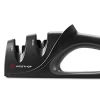
Wüsthof Two-Stage Handheld Knife Sharpener

- Editor-approved
- Easy to use
- Good for beginners
- Not suitable for all knives
“This is one of those products that you forget you need until you need it," says Shop TODAY editor Vivien Moon. "I have had this one for a few months now and I think I raved about it for two days straight telling my friends this is what they’re all getting for Christmas. It’s so easy to hold and place on the counter for stability and to sharpen both knives and scissors.”
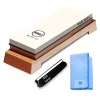
King Whetstone Starter Set

- Great for beginners
- Includes two grit levels
- Slight learning curve
Pro chefs and knife experts alike — including Betanzo — swear by King for their whetstones. This starter set includes two medium and fine grade stones for sharpening and refining your blades.
Shapton #320 Grade Whetstone

- Expert-recommended
- Best for extremely dull knives
- Has a learning curve
If you’ve never used a whetstone to sharpen your knives and have a knife that’s in need of a whole lot of TLC, start with this coarse grit whetstone by Shapton, a brand that Yamato recommends. The number corresponds to the coarseness of the stone (the lower the number, the coarser the stone).
Note: While MTC Kitchen imports and distributes Shapton products, Yamamoto’s recommendation comes independent of that and is not personally affiliated with the brand.
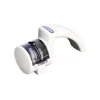
Suehiro Ceramic Water Wheel Sharpener

- Expert-recommended
- User-friendly
- Mimics whetstones
- Not suitable for all knives
Although knife experts agree that using a whetstone is the best way to sharpen a knife, we understand that the process is an intimidating one. “If freestyle sharpening feels like too much of a challenge, then the Suehiro Handy Sharpener is a good alternative,” says Yamamoto.
Note: While MTC Kitchen imports and distributes Suehiro products, Yamamoto’s recommendation comes independent of that and is not personally affiliated with the brand.
Wüstof 10-Inch Honing Steel

- Chef-approved honing steel
- Easy to use
- Slim for easy storage
- Not best for very dull blades
The executive chef of a French restaurant I used to work at introduced me to this honing steel from Wüsthof. I use it to hone the blades of all of my knives — from petite paring knives to all-purpose chef’s knives. It’s comfortable to hold and transforms dull blades in seconds.
Horl Rolling Knife Sharpener

- Chef-approved
- Easy to store
- Best for advanced home cooks
“It’s very easy to use and easy to keep handy with our limited storage," says Nikko Cagalanan, a James Beard-nominated chef, of this rolling knife sharpener. "It’s compact, but still very effective.”
Shapton Glass Stone Set

- Multi-piece set
- Chef-approved
- Expensive
"These are by far my favorite set of stones to use for sharpening my knives whether using German or Japanese steel," says Adam Bresnahan, the executive chef of The Ruffed Grouse Tavern. "They provide a perfect blade and sharpness every time."
What is the proper way to sharpen a knife?
Experts recommend using a combination of whetstones and a honing steel (also known as a sharpening steel) to revive dull blades:
- Betanzo recommends starting with a coarse whetstone with a grit of approximately 320. Most whetstones need to be soaked in water for about five minutes before using.
- Once ready, remove the whetstone from the water and gently press one side of the blade of your knife against the stone. Place the heel (base) of the blade at the top of the stone and use light pressure to bring the blade towards you at a 15-degree angle.
- Repeat this process about 10 times, then flip the blade over and follow the same steps.
- Next, switch the whetstone out for one that has a grit of 1000 to 1500, which is considered medium grit and will help to refine the blade.
- Repeat the steps above, being sure to maintain a wet surface on the stone.
Once you’ve finished sharpening your knife, it’s time to hone!
- Take your honing steel and hold it in your non-dominant hand. Hold one side of your blade of your knife against the rod and drag the blade in a downward motion from heel to tip.
- Repeat with the other side of the blade and continue for about 30 seconds.
More products to help keep your knives sharp
Messermeister 8-Inch Chef’s Edge-Guard

- Inexpensive
- Protects knife blades
- Only fits certain knife blades
Keep the blades of your knives protected with this under-$10 plastic knife guard. It fits most eight-inch blades and will help to prevent the blade from damage when it’s stored in a drawer with other utensils.
I have these guards in several sizes for all of my knives — from 3-inch paring knives to 10-inch bread knives — and can’t recommend them enough.
Schmidt Brothers Acacia Magnetic Wall Bar

- Fits 8 to 10 knives
- Saves counterspace
- Protects knife blades
- Installation required
- Wall mount only
From traditional knife blocks to magnetic wood blocks, there are so many different ways to store knives — but this wall-mounted magnetic bar is my favorite. Not only does it free up precious counter space, it protects the blades of my knives because they’re not jammed into a drawer or block. I’ve had it mounted to my wall for three years and have never once had a knife slip off the wood.
Frequently asked questions
A whetstone is a hard stone that’s soaked in water. Whetstones are available in different grades that correspond to how coarse they are.
A honing steel is a long rod made of high-carbon steel and plastic. This tool realigns the teeth of the knife when they’ve bent out of place during regular use, says Yamamoto. It’s also a quick trick for sharpening your blade quickly.
Hand-held knife sharpeners — which are sometimes called manual knife sharpeners — rely on a pull-through motion to sharpen the blades. These are often considered the easiest and most accessible knife sharpeners on the market, but Betanzo does not recommend using these.
“If you don’t do it right, you kind of make waves on the edge,” Betanzo explains, adding that using this style of sharpener can often cause more damage to the blade.
“Hand-held pull-through sharpeners are convenient and easy to use, but they can remove too much material from the blade and may not give as fine an edge as a whetstone,” says Yamamoto.
If you were to look at a new knife under a microscope, you'd see “tiny, saw-like teeth along the blade,” says Yamamoto. As a knife dulls with repeated usage, those teeth go away.
“Sharpening is the process of bringing those tiny teeth back to life by removing a small amount of metal and creating a new edge,” he explains.
Whether you’re just learning how to cook or take the lead in the kitchen, there are a few basic knives every home cook should own.
Bread Knife
A bread knife is a serrated knife with a long blade that’s usually about eight to nine inches in length. This sturdy knife is best used for slicing baguettes, artisan boules, ciabatta bread, homemade sourdough loaves and more. We also like to use a bread knife for cutting tomatoes, as the serrated blade doesn’t crush the fruit and yields cleaner, more even slices.
Boning Knife
There’s a good chance that you’ll find yourself reaching for a boning knife on Super Bowl Sunday. That’s because it’s the best tool for trimming the fat off of meat, such as pork shoulder or even a tenderloin. It’s also great for butchering whole chickens and a Thanksgiving turkey. This knife tends to feature a five- to six-inch blade that’s easy to handle. In some cases, the blade is curved, which makes it easy to work around the bone or skin.
Chef’s Knife
If there’s one knife that you should own, it’s a chef’s knife. This all-purpose knife can do just about any task, from prepping vegetables to cutting a slice of birthday cake. As a former restaurant line cook, I recommend that home cooks choose an 8-inch chef’s knife, which will be comfortable to handle and suitable for nearly every task.
Paring Knife
When you have smaller tasks like segmenting citrus or slicing cherry tomatoes, grab a paring knife. This petite knife, with a blade that’s about three inches in length, will come in handy for quick prep.
Santoku Knife
Think of this as an alternative to a chef’s knife. This Japanese-style, multi-purpose knife features a blade with a downward curve at the tip (rather than coming to an angled point). One other common characteristic that you’ll see on the blade of most santoku knives is a series of hollowed depressions, which help to prevent food from sticking to the blade.
Utility Knife
This isn’t your dad’s workbench knife. Much like its name, this is another all-purpose knife that you can use for everything from slicing cheese to cutting strawberries and everything in between. With a six-inch blade, it’s bigger than a prep knife but smaller than most chef’s knives, which makes it a great choice to grab.
How we chose
Shop TODAY interviewed chefs and knife specialists about how often you should sharpen your knives and the best way to do so. We shared products that experts and editors gave their seal of approval on to help you revive dull blades and protect your knives.
Meet the experts
- Masayuki Yamamoto is the in-house Japanese knife specialist at MTC Kitchen, a restaurant and kitchen supply store with locations in New Jersey and New York.
- Humberto Betanzo is the in-house knife sharpener at Whisk, a kitchen supply store in Brooklyn, New York.
- Nikko Cagalanan is a James Beard-nominated chef at Kultura in Charleston, South Carolina.
- Adam Bresnahan is a chef at The Ruffed Grouse Tavern in Highlands, North Carolina.


