

Retinol, a synthetic derivative of vitamin A, is often touted as one of the most powerful skin care ingredients out there. Although retinol is known to be a skin care wonder that can dramatically prevent and minimize fine lines and wrinkles, brighten skin, reduce breakouts, and fade hyperpigmentation (yay), it can also aggravate it significantly on first use (nay).
Trust us, the initial redness and dryness are a small price to pay for the eventual results. Still, you can help minimize the negative effects of retinol by incorporating a top-notch face moisturizer into your retinol routine. Editors and experts share their favorite moisturizers to pair with retinol, along with professional tips on which ingredients to prioritize in your skincare routine.
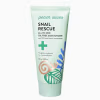 Budget-friendly moisturizer$undefined$16.88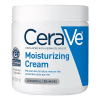
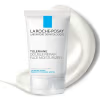 Best for sensitive skin$undefined$24.99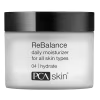


Editor-tested moisturizers to pair with retinol


“I just started using a retinol serum, and I often use this moisturizer afterwards,” says former commerce editor Amanda Fama. “It has super hydrating ingredients like squalane, snail mucin concentrate and hyaluronic acid, so it leaves my complexion feeling super fresh and soft. I usually switch back and forth between this one and the oil-free version, which is a bit less greasy feeling,” she explains.


“I was looking for a more affordable moisturizer and this one was recommended to me by a Sephora employee — it is the only moisturizer I will ever use,” says editorial operations manager Jillian Ortiz.
“It has a light feel and I love that when I combine it with other products, I can still feel them working. It isn’t overpowering,” she added.
This moisturizer contains two ingredients experts recommend when choosing a moisturizer to pair with retinol: niacinamide and ceramides.

Expert-approved moisturizers to pair with retinol


This bestseller has won the hearts of Amazon shoppers and has also earned the respect of board-certified plastic surgeon Dr. Troy Pittman.
"It uses micropearl technology to absorb excess oil and has glycerin, which keeps the skin smooth and soft,” he tells us.
Although it’s not recommended to use retinol during the day, if you happen to for any particular reason, know that this formula contains SPF 30, which is helpful to pair with retinol as it increases your skin’s sensitivity to the sun’s rays.
Pittman also reminds us that it's essential to apply sunscreen throughout the day, and says that this lightweight formula won’t clog pores, making it particularly great for those with combination or oily skin.

Pittman lists glycerin and hyaluronic acid as the two powerhouse ingredients in this Neutrogena gel cream, saying it has a number of great benefits for your complexion.
“It has no fragrance, is dye-free and restores the skin’s natural barrier against moisture loss. This moisturizer quenches extra-dry skin, relieves intense dryness and leaves the skin looking smooth, which is excellent for those using retinol,” he says.
Many verified Amazon shoppers agree, and more than 6,100 of them gave it a five-star rating. One user noted, “Love this moisturizer, especially for the price. I’m currently using a topical retinoid, which can really dry out the skin. This has been my saving grace.”

Prefer a more streamlined ingredient list? Boston-based, board-certified dermatologist Dr. Ranella Hirsch loves the fact that this lotion is free of dyes and fragrances. “It makes it a great, light option for even sensitive skin types trying to get started on a retinol,” she said.
It also helps soothe red, irritated, cracking or itchy skin. The bestseller also happens to be quite popular with Amazon shoppers, who’ve given it over 8,600 verified five-star ratings.

“Retinols function by revving up cell turnover. This can — and frequently does — yield some level of irritation and/or dryness,” Hirsch explains, adding, “Judicious use of a good moisturizer can help counter this for a beginner user or even someone who has been using it for a long time.”
The derm is a fan of this gentle, noncomedogenic moisturizer that works for all skin types.
“It offers long-term hydration with ceramides and glycerin,” she shares. Add it to your routine after retinol and let the formula do its job — it’ll provide 24 hours of hydration thanks to key ingredients like ceramides and hyaluronic acid.


“CeraVe PM Moisturizing Lotion is my other favorite, as it is also great for all skin types,” says Dr. Kseniya Kobets, Director of Cosmetic Dermatology at Montefiore Einstein Advanced Care.
This 2023 Shop TODAY Beauty Award winner contains hyaluronic acid, glycerin, niacinamide and ceramides — these ingredients lock in moisture but don't feel greasy on the skin. Although it says PM, you can use it in the AM as well, the dermatologist notes.
One Beauty Awards product tester noted, “I love how much it actually moisturizes, since it feels pretty light. And I like the pump, it’s easy to get out with one hand, rather than other most expensive moisturizers that you have to scoop. It makes it easier for me to use every night since it doesn’t feel like such a hassle or a process. (I also have used it in the morning sometimes because it’s convenient).”

Give your skin a double dose of hydration with this moisturizer. The main ingredients? La Roche-Posay’s prebiotic thermal water (a soothing antioxidant), ceramide 3 (a skin-identical lipid that helps retain moisture) and niacinamide (a water-soluble vitamin to soothe and restore skin).
After just one hour, it repairs the skin’s protective barrier and keeps it hydrated for 48 hours — yep, that’s two full days. It’s also fragrance-free and made with sensitive-skin types in mind. So, especially if you’re new to the retinol game, this hydration-heavy formula will help counteract irritation so you can put your best face forward.
Kobets notes, “I advise my patients to avoid the UV-containing version (they look very similar, so be careful), since it is a chemical blocker and can cause skin sensitivity. Plus, since most retinoids are used at bedtime, we do not need one with SPF.”
She adds, “It also comes in a matte version, which is great for patients who do not want to worsen their oiliness.”

Don't be surprised if your skin rebels a bit when you first start using retinol.
"Especially early on, retinoids cause an exfoliation of the keratinocytes, and that can disrupt the lipid barrier," board-certified dermatologist Dr. Mary Lupo shares, adding, "It is worse in very dry climates and during the first few weeks of use."
The skin care expert recommends using a soothing moisturizer to combat those initial growing pains and named this Aveeno oat gel moisturizer as one of her top picks.
"It's a great choice as a hydrating gel in humid climates and for acne-prone skin," she says.

Parks notes this lightweight gel as a great nighttime moisturizer option.
"It locks in moisture and protects the moisture barrier. It uses a strong combination of aloe, hyaluronic acid, glycerin and other natural extracts to gently but effectively hydrate the skin and protect it from damage," he says.
One Ulta user raved, “This moisturizer is my holy grail product. It's the perfect calming moisturizer for during the day and layers very well with other products. Perfect to soothe the skin! 10/10.”

Ever wonder why your skin gets so dry while using a retinol?
Parks breaks it down for us: "Retinol increases the rate that your cells turn over exponentially, producing the anti-aging effects you know and love. This means that your skin gets rid of its old skin layers faster than usual, which can cause a significant amount of dryness and flaking."
The derm swears by this lightweight cream that works equally well for all skin types, even oily ones.
"If you have oily skin, adding that moisture back into your skin is important and can actually help regulate oil production in your skin," he says.
This cream is light yet nourishing, with ingredients like antioxidants, vitamin B5 and niacinamide.
More editor-recommended retinol products

Social media video producer Anita Chomenko isn't new to retinol serums and creams, but she says this one from E.l.f. is one of her favorites to date. "It left my skin feeling soft and moisturized, and it didn't have any off-putting scent," she says. She adds that when she applies it at night, it makes her skin look much brighter by morning.

Commerce writer Emma Stessman says she noticed a big difference in her skin while using this retinol moisturizer. "It definitely helps with uneven texture and fine lines," she adds. "It's also more moisturizing than other retinol formulas I've tried, so it doesn't dry out my skin as much."

Former media coordinator Lauren Biggerstaff says this K-beauty product from Innisfree is a "non-intimidating" retinol for beginners or anyone with sensitive skin. She adds that the formula feels silky smooth on her skin and never causes redness or irritation.

After trying multiple retinols that end up leaving her dry and sensitive skin looking red and irritated, editor Shannon Garlin finally found this game-changing product from Paula's Choice. "It contains the brand's own "retinyl" complex along with niacinamide and glycerin, which leaves my skin feeling refreshed, firm and hydrated," she says. "I've used it once or twice a week for over a year and haven't had a reaction yet!"

Deputy editorial director Alexandra Deabler recommends this face serum for anyone who is just starting out with using retinol. "It's a very gentle retinol and doesn't give me a lot of redness," she says. "I used it every other day for about a week, and then went to every day. It's made a big difference in the glow of my skin."

Deabler is also a fan of this cream and says, "It’s pricey, but it absorbs great and makes my skin really soft."
This cream features a ceramide complex designed to strengthen the skin barrier while helping to combat dehydration and the appearance of wrinkles.

Commerce writer Jannely Espinal loves this cream for its buttery and luxurious feel. "I’d never seen a cream with such a steep price tag, so I had to try it for myself — and wow. The texture is incredibly rich, so a little truly does go a long way. It melts into the skin with a creamy, velvety glide that delivers deep hydration. After using it through winter, my skin has never felt softer or more supple. It’s easily one of the most indulgent moisturizers I’ve tried," she adds.

What to look for in moisturizers when using retinol
“In the first two to four weeks, the skin undergoes a process known as retinization, where the skin cells adjust to the retinol itself. This can lead to dryness, flaking and redness. That is why it is so important to pair your retinol with a moisturizer,” says Dr. Joshua Zeichner, board-certified dermatologist and Director of Cosmetic and Clinical research at Mount Sinai Hospital’s department of dermatology.
Of course, every person’s skin is different, and it’s best to consult a dermatologist for personalized recs, but here are some of the common ingredients experts say we should be looking for while shopping for a moisturizer to pair with retinol.
- Niacinamide: This ingredient “helps build cells in the skin while also protecting them from environmental stressors such as sunlight, pollution and toxins. It also plays an important role in soothing and helping to restore the skin barrier,” says Dr. Liia Ramachandra, a former pharma executive and skin care expert.
- Ceramides: Think of these lipids as the glue that holds our skin cells together. “These are the building blocks in the skin and are lacking in those people who have disrupted skin barrier (patients with rosacea, eczema and even acne!),” Kobets says. “We now know that the sebum (or oil) produced by acne-prone skin is lacking proper ceramides, and thus we must stop over-drying the skin by stripping it with harsh cleansers and toners, and [we] need to start using products containing ceramides.” This is especially important for acne patients who must use a retinoid, which, while proven to help with oiliness, inflammation and even acne scarring, still needs to be applied to skin that has a proper barrier.
- Hyaluronic acid: Ramachandra also emphasizes this ingredient, known to soothe inflammation and help strengthen the skin. She notes, “hyaluronic acid can also be used to plump and hydrate skin.”
- Naturally derived oils: “I would choose naturally derived oils over synthetic ingredients,” says Greenfield. “Retinols make your skin more sensitive, even if you don’t have sensitive skin normally. Because of this, choose ingredients that are gentle yet effective.”
What’s the difference between retinol creams and retinol serums?
But first things first: How are retinol serums different from retinol creams?
Kobets tells us, “The terms ‘serums’ and ‘creams’ are often used interchangeably, and their consistency often depends on the brand that you buy. Some serums are like lotions and others are waterier, others more oily.”
Either way you go, know that pairing a moisturizer with your retinol treatment is still essential in your routine (more on the order of application in our FAQs section below).
If you have sensitive skin, it’s imperative that your skin barrier is reinforced or repaired before using a topical retinoid, which can irritate the skin, says Kobets. “Once the skin barrier dysfunction has been fixed and maintained, we can start adding topical retinoids (from over-the-counter to prescriptions),” she adds.
Frequently asked questions
“If your skin is dry, use the moisturizer prior to applying the retinol. If your skin is normal to oily, apply it after the retinol,” says Greenfield. She adds, “The order does not change if the retinol is serum versus cream, but you may need to add more hydration if using a retinol serum.”
Kobets understands that it may be confusing why we would apply a retinoid after moisturizer since we want to reap all the benefits of anti-acne, anti-aging and anti-pigmentation of the product that we acquired. She explains, “Most people will have some sort of irritation with topical retinoids when starting it, so this application blocks some of the action by diluting the retinoid. I would prefer to build up the tolerance to a retinoid than someone stopping it completely and not using it at all. I say consistency and less is more [are] what gets you results.”
Remember: When using retinol, it’s a marathon, not a sprint.
Kobets says, “If it takes someone weeks to months of using a retinoid once a week to increasing it to twice a week, I am still happier than someone starting to use it daily, getting irritated and completely stopping because they ‘cannot tolerate it’ or ‘have an allergic reaction to it.’”
The theory of a “retinol sandwich” (applying moisturizer first, then retinol, then another layer of moisturizer) can be extra hydrating and beneficial for someone who has very dry skin.
“Also, when following the logic of using hydrators like hyaluronic acid and glycerin-containing serums , then locking them in with moisturizers like ceramides and niacinamide, one may want to apply a serum or a cream that has hyaluronic acid and ceramides before retinol and then serum or moisturizer that has ceramides and niacinamide to lock in the moisture,” Kobets explains.
Retinol doesn’t pair well with anything that can over-exfoliate skin, like hydroxy acids, notes Kobets.
“It can cause more irritation, thus should be avoided the same day as a retinoid. Physical exfoliants like St. Ives Scrub feels great on the skin; however, they can damage the skin barrier and exacerbate the irritating side effects of topical retinoids.”
Kobets also cautions patients to avoid combining too many new topicals when starting a regimen.
“I generally recommend avoiding heavily fragranced products, especially in sensitive-skin patients, as they can develop sensitivity to fragrances and other allergens as ingredients in many topicals," she says.
Another ingredient Kobets advises not to mix with retinoids is benzoyl peroxide , as it has been said to deactivate each other when used together. But there’s an exception: “In my opinion, if you are using benzoyl peroxide as a spot treatment , it should be okay,” she says.
“I tend to recommend using topical retinoids at night, especially if patients are hydrating more, which may not mesh with makeup and feel greasier in the morning,” Kobets says.
Another reason to use a topical retinoid at night, she adds, is that most of them get inactivated by the sunlight, and some even have questionable activity in the sun.
In this day and age, although we do need to invest time in our mind and body health, no one wants to spend hours applying creams before bed. Kobets explains, “It is okay to apply a moisturizer right after a retinoid if it feels like it has all been evenly distributed and absorbed into the skin.”
How we chose the best moisturizers to use with retinol
In a sea of moisturizer options out there, how did Shop TODAY narrow it down?
First, we looked to our trustworthy sources: dermatologists and skin care experts who gave us their take on effective products. We then took into consideration their notes on which specific ingredients to look for.
Meet the experts
At Shop TODAY, our reporters interview a range of qualified sources and experts to capture a wide scope of perspectives on a given topic. We also make sure that all expert guidance and recommendations are made independently and with no undisclosed financial conflicts of interest.
- Dr. Joshua Zeichner, MD, FAAD, is a board-certified dermatologist and Director of Cosmetic and Clinical Research at Mount Sinai Hospital’s Department of Dermatology in New York City. He has expertise in cosmeceuticals, cosmetic dermatology, and treatments for acne, rosacea and more. Zeichner is also the medical advisor for Jori Skincare.
- Dr. Liia Ramachandra, Pharm.D., Ph.D, is a former pharma executive and skin care expert based in Canoga Park, California. She is the CEO and founder of skin care brand Epilynx.
- Dr. Kseniya Kobets, MD, MHS, FAAD, is Director of Cosmetic Dermatology at Montefiore Einstein Advanced Care in Westchester, New York. She specializes in treatments for acne, acne scarring, rosacea, hair restoration and more.
- Dr. Troy Pittman, MD, FACS, is a board-certified aesthetic plastic surgeon based in Washington, D.C. He offers the full spectrum of plastic surgery procedures and is internationally recognized for his expertise in the aesthetic and reconstructive surgery of the breast and body.
- Dr. Ranella Hirsch, MD, FAAD, is a board-certified dermatologist based in Boston. She has expertise in cosmetic and laser dermatology and serves on the boards of several dermatology journals, including Dermatology Times, Cosmetic Dermatology, The Dermatologist and Cutis.
- Dr. Mary P. Lupo, MD, is a board-certified dermatologist and clinical professor of dermatology at Tulane University School of Medicine. She practices in New Orleans, Louisiana.
- Dr. Alan Parks, MD, is a board-certified dermatologist and founder of DermWarehouse, as well as Eastside Dermatology & Skin Care Center in Columbus, Ohio. He focuses on cosmetic and surgical dermatology, laser treatments, Botox cosmetic services, and skin cancer surgery.
- Dr. Nava Greenfield, MD, is a board-certified dermatologist at Schweiger Dermatology Group in New York. She also works with REN Clean Skincare as a third-party expert. Greenfield is a member of the American Academy of Dermatology and has been published in several medical journals, such as The Journal of Dermatological Treatment and the Journal of Women’s Dermatology and Pediatrics.

Illy Whole Bean Coffee Classico (Medium Roast)

Illy Whole Bean Coffee Classico (Medium Roast)
