

While social media may have you believing that everyone and their mother has run a marathon, that's not the truth. (You may have heard the statistic that only around 1% of the world’s population has run one, and according to Marathon Handbook, that's a pretty accurate estimate.)
However, it is true that an increasing number of people are hoping to take on the feat. This past year, the major marathons — including New York City, Chicago and London — each saw a record-breaking number of applicants. (Case in point, over one million people applied for London's 2026 race, the most ever for a marathon event.)
Two years ago, I ran my first marathon, the New York City Marathon, after swearing for years that, even as a lifelong casual runner, it was something I would never do. And while I enjoyed the process, I knew I made quite a few mistakes in my training. So when Athleta reached out to me earlier this year asking if I wanted to run a marathon, I jumped at the opportunity to try again. I completed the Chicago Marathon in early October and the whole training process felt astronomically better than last time.
Part of my success was thanks to the guidance I had along the way. Athleta paired me with running coaches and group fitness instructors, Amber Rees and Lindsey Clayton, who founded Brave Body Project in New York City. They created a comprehensive plan for me and scheduled monthly meetings to make sure I was on the right track. I also got some advice from Jenna Wrieden, an assistant coach for Hoka's Northern Arizona Elite pro training group, who is helping me train for a different race but had plenty of helpful insights to share.
But not everyone has the resources to work with a coach. That's why I tapped the three experts, along with Ciara Lucas, a running and fitness coach (who helped two fellow Shop TODAY staffers and first-time marathoners train for the New York City Marathon), to share their guidance for first-time marathon runners, from the products you need to how to prepare before training even starts. Their insights were exactly what I wish someone had told me before I ran my first race, so with these tips in your back pocket, you should be set up for success.

 The best sneakers for training$147.92$164.13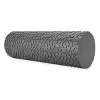


Can anyone run a marathon?
If you're anything like me, you've probably looked at the people who run marathons and thought, "That could never be me." Before I ran my first race, even after I ran a half-marathon, that's exactly how I felt. But you don't have to be a serious runner now (or even a runner at all) to successfully train for a marathon. Almost anyone with the ability to run can chase the goal.
"If you’re ready to commit the time, energy and effort that’s required to get through training, anyone can run a marathon," Clayton shares.
How long does it take to train for a marathon?
The number of days that you will spend training every week is based on your fitness level, personal goals and schedule, Rees shares. However, she adds, the most common training plan includes four days of running and two days of strength training. Rees and Clayton built me a 20-week plan that followed that formula and included a “build” period and a mix of speed work, recovery runs, strength training days and a long run throughout the week.
There are tons of free plans online (simply search "free marathon training plan" and you'll get pages of results from reputable brands), so you should easily be able to find one that matches your goals and time constraints.
If you're someone who is completely new to running, it's a good idea to give yourself some time before you start your plan to build up a base of fitness (you can read more about that process in the FAQs below). And, Wrieden says, it might even be a good time to try to run a race like a 5K or 10K if you haven't before just to get yourself used to a racing environment. All that's to say, if you have your eye on a certain marathon, it's a good idea to give yourself plenty of time to prepare.
How fast should your marathon training runs be?
For those just getting into running, determining your ideal pace can feel a bit overwhelming. That's why Wrieden suggests thinking about effort first. "Try a scale of effort of one to 10, where one is walking and 10 is the hardest effort you've ever put out."
Say your plan includes one easy run, one marathon pace run and one run with speed intervals per week. Wrieden says your easy pace should feel like "a three out of 10," your marathon pace should feel like a "five or six" and your speed work effort should be "above six." Try using the effort scale for about a month. From there, if you have a fitness tracker, you can use it to determine what your efforts equal in pace.
One mistake that I made during my first marathon, and many others do as well, is running "easy" runs too fast. It's natural to want to push yourself, especially if you're feeling good, but running all your runs at a hard pace is a surefire way to make yourself tired and burn yourself out.
"An easy run is done at an aerobic pace that doesn’t make you breathless. You should be able to hold a conversation or sing along to music at this pace," Lucas says. "Easy runs build your aerobic capacity, which is crucial for running a marathon since it’s all about endurance."


Why are strength training and recovery days important?
Yes, being able to run is a huge part of marathon prep, but what you're doing on non-running days matters, too.
During my first race, I felt like I was constantly on the verge of getting injured. Even easy runs would end with aching joints, and on long run days, I could barely move afterward. This time, I walked away from the marathon injury-free with minimal pain and I often walked around and went about my day after long runs, without feeling too sore.
So what made this time around feel so different? The plan Rees and Clayton created for me included two days of strength training per week, while the one I had previously followed didn't have any built in.
"Strength training is essential in preventing injury and [it] strengthens a runner’s muscles and joints," Rees says. "It helps with power, agility and running economy."
Your strength sessions don't have to be "long or complicated," Lucas says. "Sessions can be 20 to 30 minutes and focus on movements that work the core, glutes, hamstrings and hips."
Rees and Clayton sent me a list of suggested exercises for these days, which included dumbbell exercises like squats, single-leg deadlifts, glute bridges as well as push-up, planks and more.
Depending on your plan, you will likely also either have one or two recovery days per week.
"Recovery is just as important as running during marathon training," says Lucas. "If we don’t allow our bodies to recover from hard workouts, we can’t effectively make progress in our fitness. When you train, you’re actually creating small amounts of stress and micro-damage in your muscles. Recovery is when your body rebuilds stronger, fitter, and more efficient." And if you don't take them, you're more likely to experience fatigue and overuse injuries.
Your recovery days could look like days off where you rest, stretch and give your body plenty of TLC. Or, you try a more active form of recovery, "like a yoga session or a walk on a trail," which will "get the blood flow going to the working muscles," without putting too much additional strain on your body, Wrieden says.
More of the best marathon training tips from experts
Here are some of the other things Wrieden suggests keeping in mind as you’re training.
- Lean on your community: “The marathon is not necessarily about being alone,” says Wrieden. “I think there are definitely miles and times in your training block where you do have to grind it out alone, be tough and see what you’re made of ... but you’re always going to have support around you. That’s the cool thing about the marathon. There’s going to be someone on the corner cheering for you, there’s going to be other people attempting their first marathon. And I think when you start telling your friends and family about what you want to do, then they’re going to be like super invested in what you’re doing as well. And that’s a game changer.”
- Create a positive environment for your runs: Almost every runner will go through a point in their training where they dread a run or question why they signed up in the first place. If you get to that place, try to flip your mindset. “You never want running to be a source of anxiety or stress,” Wrieden says. “You want it to be more of a level of excitement. You can always be nervous, but you can use that nervousness as excitement. Yes, you have this 13-mile long run that’s on the docket, but last week you did 11, and you know that you’ve prepared for it.” Try making a plan to meet friends after, wearing an outfit you love or running with someone else to give yourself something else to look forward to.
- Embrace the challenge: No one signs up for a marathon because they think it will be easy. When it gets hard, remind yourself that you'll be coming out stronger on the other side. “You have to have a level of acceptance that if you are going to do this race and the work that it requires, it is hard,” Wrieden says. “There’s no way around it. And I think that’s the cool thing about it. You accepted this pretty tough challenge, mentally and physically, you have to put your body and your mind through some tough places ... this is going to be difficult and that’s OK.”
If you're feeling ready to start training, we're sharing some of the products that I, the experts and other Shop TODAY marathoners swear by for their runs and recovery.
The marathon training apparel and accessories, according to editors

"I carry this portable water bottle which feels lightweight and is easy to place inside the belt even while running," shares first-time marathoner and Shop TODAY writer Jannely Espinal.
It has a curved design, which the brand says fits the curves of your body, so you can easily carry it in your running belt.

Editor and producer (and two time marathoner) Julie Ricevuto calls these socks "perfectly cushioned." She shares, "These socks are my best protection against blisters while running. They are no-show but still stay put and don’t slide down while you run."
I am also a huge fan of these socks and they were my go-to for long runs and on race day. They're cushioned in all the right areas, so they serve as extra protection for your feet from blisters and aches.


"I could talk ad nauseam about these socks. Before I started marathon training, I had no idea it truly mattered which socks you wear, especially for longer runs," shares associate editor Sierra Hoeger. "But when I started adding mileage each week and climbing into 13+ mile territory each weekend, I found myself reaching for Feetures every single time. They’re designed with cushioning in spots where you’re more prone to blisters, like the side of your feet and the top of your toes. I’ll never forgive myself for the day when I didn’t wear them on a long run and got blisters in those exact spots."
Fellow first-time marathoner and associate editor Kamari Stewart also raves about the brand's socks. "I’m a back-of-the-pack runner so I’m out there for a longer time than most and the wrong socks can very easily give me a blister (as I learned the hard way)."

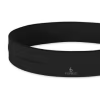
"A waist belt is a great addition to help you hold extra gels or your phone while running without weighing you down," says Rees.
Hoeger has been using this belt on her runs. "It’s more spacious and has way more pockets compared to the old belt I was using. It can hold my phone, keys, all the fuel mentioned above, an ID and my compact water bottle. And, it doesn’t move while you’re running."
Senior social media editor Kate McCarthy has run four marathons and is a recent Flipbelt convert. "I just started using this and it’s been super helpful. It moves sort of high up on my waist, but it doesn’t bounce up and down wildly like some other belts I’ve used, so therefore, I love."

This was the bra that I reached for by far the most in my training — in fact, I love it so much I now have three colors. (When two other editors and I spent a month testing it, along with six other options, this one came out on top as the best of the best.) It's comfortable, supportive, flattering and it keeps everything securely in place, even during double-digit mileage runs.


The best workout gear is the kind that you don't even have to think about during your runs, and this top fits the bill. It was what I wore for race day and I was so glad I did. It has a seamless construction, so there was no chafing, even under the armpits, where I sometimes have issues. And the material has little holes all over, so it's super breathable. The hem also has little grippers to prevent it from riding up.


While I typically like to run in biker shorts, when it's cooler outside, I often opt for these leggings. They're super soft, sweat-wicking and easy to move in. Plus, they come in plenty of different sizes and styles.

This sports bra was another go-to for me throughout my training. I loved the Velcro in the back, which allows you to adjust the fit to match your body as it inevitably changes throughout the months of training. It also has an open back, which allows for plenty of airflow.

"I really like training with the Adidas Adizero Running Gel Pocket Crop Top because it can fit multiple things around the top," Espinal says. "It has multiple pockets on the sides, front and back to place your fuel."


"This is one of the most comfortable hydration vests I’ve worn and it has so much storage," shares Lucas. "It’s perfect for carrying several water bottles, energy gels and any other items you need with you on a long run."
After struggling through a few hot and humid runs, my coaches suggested that I get a hydration vest and the brand sent me this one to try. I expected to feel weighted down and uncomfortable, but that was not the case at all. It was comfortable and I never had to adjust it or pull it down. I also couldn't believe how much I could fit in here! For a 20-mile run, I loaded it up with multiple packs of gummies, two water bottles, my phone, keys and headphones and still had space for more.

The best shoes for marathon training, according to experts and editors

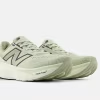
I have dozens of running shoes in my closet at any given time (it's a huge perk of being a fitness writer), but these are the ones that I reach for the most often, whether it's for marathon training runs or to help my feet stay comfortable the day after a long run. They are what I consider to be the perfect everyday sneaker, working well for everything from easy recovery jogs to high-mileage days at race pace. They have the perfect amount of comfortable cushioning to help prevent some of the aches and pains that come with training, while still keeping a level of firmness to help prevent you from totally sinking into the shoe. While I had a few other shoes in my training rotation, you could easily do all your runs and even your race in these.


McCarthy has worn different iterations of these sneakers for marathons, half-marathons and training through the years. "I’ve spent years training for marathons in these shoes, slogging through rain, snow and blistering hot days, and my feet always feel cushioned and protected," she shares. "Out of all the possible gruesome running injuries, the only one I have suffered with all of the marathon training I’ve done is a single black toenail. That’s it. No blisters, no ankle sprains, no missing toenails, nothing."
She adds, "Lacing up these sneakers before training runs or races, I never have to worry how my feet are going to interact with them, I always know they will be happy once my run or walk is over, no matter how far I plan on going that day — and when I say these shoes last, I mean it."

“You must have a good pair of running shoes before you begin training,” says Lucas. “This is an extremely personal experience because everyone’s feet are different. Go to a specialty running store and have your feet properly fitted to find the right shoe for you. It’s worth doing this process so you can avoid foot pain in the future. I personally prefer a high cushion shoe to support me on long runs, and my favorite is the Nike Vomero 18.”

Ricevuto calls these her "favorite running shoe for long runs." She adds, "They’re super supportive, cushioned and have the perfect amount of bounce to them."

"I recently converted to the Asics Gel-Kayano 32 for distance running and it’s made a crazy difference," Stewart shares. "I was in virtually no pain at the end of an 18-mile run while wearing this, versus the excruciating pain I was in in a different pair of shoes at the end of a 15-miler."

For long runs and race day, I opted for Hoka's Mach X 3 sneaker. It features a Pebax plate — a variation of the carbon plates that are common additions to racing shoes — that is designed to help enhance energy return, meaning that, theoretically, you run faster and more efficiently. While there's some debate in the running world about whether carbon-plated shoes actually do much for slower runners, research shows that they actually can help those who run 4+ hour races (the results just might not be drastic). However, even as an over 5-hour racer, I find that when I'm wearing plated shoes, like these, I notice that I am able to run faster for longer. These, specifically, are perfectly snappy and bouncy to propel you forward with each step — and they're super comfortable, too.
One thing I will note is that the toe box can be slightly narrow. But I switched to a wide size and found it to be a much better fit.


These shoes are built for those chasing speed. They're super lightweight, and compared to the Machs, they feature a carbon plate that is slightly more rigid, to help give you more efficient push-offs. I used them for multiple long runs, but particularly loved them for tempo and speed workouts, thanks to their snappy and fast feel.
The best marathon recovery tools, according to experts and editors


When I was training for my first marathon and struggling with feeling sore after every run, McCarthy suggested that I try a hot Epsom salt bath — and it has become one of my go-to recovery tools. The combination of the warm water and the salts does wonders for tired muscles and helps your body wind down after all that time in an activated state.

"A simple foam roller can make recovery magic after a run," Lucas says. "Foam rolling is like a mini deep-tissue massage — it increases blood flow, breaks up tension and brings oxygen and nutrients to sore areas so they heal faster."
McCarthy likes this one, which she calls "the least sexy but most necessary purchase." "I use my Normatec Go boots because I’m often too lazy to foam roll, but foam rolling always makes me feel better. I should take my own advice and use it more."

There is nothing quite like the feeling of taking off your sneakers after a long run and slipping into something more comfortable. And these are the perfect post-run option (they're even a Shop TODAY award winner). They're made from a super squishy foam material that cradles your feet and absorbs shock, which helps minimize the soreness you may feel after all those miles.
I immediately put these on post-race and was so grateful for the comfort they offered — and the fact that they're super breathable (sweaty girls unite).


"I love this compact massage gun for a massage on the go," says Lucas. "Its compact size allows you to throw it in your bag without being too heavy, and it gives you a powerful massage that brings your legs back to life."
For a more targeted treatment, Espinal likes the brand's wearable knee device.
The best marathon fuel, according to experts and editors

Ricevuto, Hoeger and I all swear by Honey Stinger's Chews, as runners with sensitive stomachs who can't always tolerate gels. "These are my favorite! They’re delicious and they really do give me the boost I need," Ricevuto says.

"There are a lot of options when it comes to fueling for a marathon, but these energy gels are definitely my favorite," says Lucas. "I like the 'jumbo gel' so it’s easier to hit my fueling goals and this has a nice mild flavor that’s easy to eat."


"You need water to hydrate but water alone is not enough to keep you significantly hydrated because it lacks electrolytes," says Rees. That's why she recommends using Liquid I.V. or LMNT hydration packs. They include electrolytes like sodium, potassium and magnesium, which she says "are key elements that will help with performance and muscle function."
Almost all of the marathoners on our team shouted out Liquid I.V. as a must-have in their training. The brand released a caffeinated version earlier this year, which I love to use before long runs for an extra energy boost.
More of the best marathon training essentials, according to experts and editors

Runners of all levels are familiar with the struggle that is chafing. But when it comes to solutions, this is by far the best and most affordable one that I've found. I slather it on my usual problem areas, like my bra line, around my armpits and underwear line and I stay almost, if not entirely, chafe-free, even on the hottest days.

"The longer you run, the more likely you’ll experience some chafing," Lucas says. "I like applying this Body Glide on my inner thighs before I start my run so I avoid chafing altogether."
"Every runner needs this!" Ricevuto says. "Especially for running in hot or humid weather. This ensures you’ll never chafe."
It's made with plant-derived, hypoallergenic ingredients, so it's said to be safe for skin and it's easy to apply, thanks to the roll-on design. If I'm running on a particularly hot or humid day, I will apply a layer of this under the Vaseline for extra protection.


While I spent most of my training for my most recent marathon wearing the Garmin Forerunner 265, I had previously run in this more affordable model, which is a great option for runners. It has a long battery life (up to two weeks) and has plenty of helpful features for runners, including the ability to create custom workouts. And it also has training plans to help you prep for races. The more you wear it, the more customized your suggestions will be. It even gives you a predicted finish time, so you can have a better idea of what race day might look like.

During my first marathon, I forwent my years-old Apple Watch on race day and went with a screen-free tracker, because I have had some trouble with it dying during long runs. But this time, I wanted to make sure I was staying on pace, so I opted for the Apple Watch Series 11 as my race day tracker (the brand recently gave me one to try out). When you have an iPhone, the experience is way more seamless than it is with other trackers, like the above, so it's easier to pick up calls, send texts using your voice and switch your music (while also still tracking your workout), all of which I knew I would be doing during the race. Aside from some hiccups in the first few miles, where everyone's watch's GPS tends to get thrown off, it did a pretty accurate job of tracking my stats throughout the marathon. Plus, I charged it when I woke up (you can reach a full charge in less than an hour) and it lasted all morning, during the 5+ hour race and through the celebrations afterward.
Frequently asked questions
"Before training officially begins, you should be working on your 'base mileage,'" shares Lucas. "Consider this your foundation. We don’t want to start at ground zero. These are miles that build endurance, strengthen muscles, and prepare your body for the higher volume to come. Create a routine for yourself and a weekly mileage goal. Ideally you’re running 3 to 4 times a week, and can comfortably do an 8 to 10 mile long run by the time you start your training plan, but this strongly depends on the athlete."
A marathon is 26.2 miles or 42.1 kilometers.
Wreiden says that “the passion and the goal is the number one thing that’s going to get you through” training for a marathon. That’s why having a goal from the start is extremely helpful. And while your goal can be pace-based, it can also have to do with how you want to feel throughout the race or can simply be to finish the race.
During my second marathon, I found that being flexible with my goal really helped with my mental state both before and after the race. Clayton and Rees had me set A, B and C goals for myself, so no matter how the race went, I could still meet my expectations for myself. While I had set a time goal for myself, illnesses leading up to (and even during) the race made it harder to match that, but having other goals for myself helped temper some of the disappointment that I might have otherwise experienced.
The Abbott World Marathon Majors are in Tokyo, Boston, London, Berlin, Chicago and Sydney. In 2016, the organization introduced the Six Star Medal to honor the runners who completed those first six races. Sydney was added as the seventh major in 2024.
How we chose
All of the above products were selected because they helped editors and experts who have previously run or are currently training for a marathon. Many of these products were tested over the course of months of training and many long runs.
Meet our experts
At Shop TODAY, our reporters interview a range of qualified sources and experts to capture a wide scope of perspectives on a given topic. We also ensure that all expert guidance and recommendations are provided independently and without any undisclosed financial conflicts of interest.
- Lindsey Clayton is a run coach and group fitness instructor in New York City. She is the co-founder of Brave Body Project.
- Amber Rees is a run coach and group fitness instructor in New York City. She is the co-founder of Brave Body Project. Together with Clayton, she coaches and creates customized training plans for runners preparing for a variety of distances, from the mile to the marathon.
- Jenna Wrieden is an assistant coach for Hoka's Northern Arizona Elite training group. She previously coached in the NCAA and before that, she ran collegiately at Arizona State University.
- Ciara Lucas is a health journalist and fitness coach in New York City. She is an eight-time marathoner and coached Shop TODAY's Kamari Stewart and Jannely Espinal for their upcoming marathon.
How do you add Shop TODAY as a Preferred Source on Google?
Google’s new Preferred Sources feature allows users to manually select their favorite publishers and news outlets for a more customizable experience tailored directly to the reader. Once you’ve opted to receive our content, you’ll begin seeing more of our recent and trending articles displayed within your Top Stories news feed.
The easiest way to add us as a preferred source is to click here and type in “TODAY.com.” Once the box is checked and you’ve refreshed the page, Shop TODAY content will start appearing in your feed.
Paid for by Sam's Club


Paid for by Sam's Club
