

There’s a reason why many skin care aficionados and dermatologists recommend retinol; it’s essentially retin-all encompassing — even for those with sensitive skin. In other words, if you’ve been putting off incorporating retinol into your skin care routine because of certain sensitivities, that could change today.
“Retinol is the gold standard in anti-aging skin care, and there are many formulations that make it acceptable for a wide variety of skin types including sensitive skin,” explains Kunal Malik, a board-certified cosmetic dermatologist and assistant professor at Icahn School of Medicine at Mount Sinai in New York, New York. “Its benefits include collagen stimulation, improved cell turnover and better skin texture.”
Shop TODAY tapped board-certified dermatologists to learn about retinol with regard to how beginners should use it (since it can be harsh on the skin) and additional ingredients they should seek in formulations for sensitive skin. We also sought out their expert recommendations, some of which we included (in addition to our editor picks) below.
Once you treat your sensitive skin with one of these expert- and editor-recommended retinol products, you’ll regret not having started incorporating one (or more) into your skin care routine sooner.
 Award-winning retinol cream$undefined$29.49
 Editor-approved retinol cream$24.56$46.69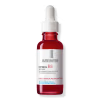


Is retinol good for sensitive skin?
Retinol can generate beneficial results for sensitive skin when used correctly. “It’s all about the delivery system, supporting ingredients and overall formulation, as stronger does not always equal better,” explains Malik.
Debra Jaliman, a board-certified dermatologist in New York, New York, adds that there are ways those with sensitive skin can make retinol a good or valuable part of their skin care routine, such as applying the products less frequently, shopping for products with lower concentrations of retinol and/or applying hyaluronic acid to their skin first for extra protection.
Ingredients to look for in retinol products for sensitive skin
Our experts note that retinol products for sensitive skin should contain ingredients to help better tolerate and balance out the retinol. “Many formulations with buffering ingredients make retinol more tolerable for sensitive skin," Malik says.
“Some great combinations to buffer the retinol include ceramides for barrier support, niacinamide for calming effects and hyaluronic acid for hydration,” Malik continues.
Jaliman recommends looking for products with glycerin whereas Geeta Yadav, board-certified dermatologist and founder of FACET Dermatology, suggests niacinamide.
“I like niacinamide because it offers anti-aging benefits that serve as a nice complement to those of retinol but also helps reduce redness, dryness, and inflammation,” she says.
Expert-approved retinol products for sensitive skin
Budget-friendly option: Azure Hyaluronic & Retinol Anti Aging Facial Serum

- Easy-to-use
- Affordable
- "Feels like water"
Key ingredients: Hyaluronic acid, retinol, collagen, aloe vera, vitamin B5 | Size: 1.69 oz. | Type: Serum
Dr. Robert Anolik, a board-certified dermatologist, previously recommended this retinol serum to Shop TODAY. He said that "it incorporates hyaluronic acid, which is another great hydrating ingredient to help reduce potential skin dryness with retinol use."
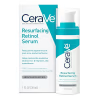
“Gentle” benefits for anti-aging: CeraVe Resurfacing Retinol Serum

- Contains ceramides
- Non-comedogenic
- Recommended to apply at night
Key ingredients: Encapsulated retinol, ceramides, niacinamide, and licorice root extract | Size: 1 oz. | Type: Serum
Ceramides are a key ingredient to look for when shopping for retinol for sensitive skin. With this in mind, James Kilgour, the founder of KilgourMD and the resident dermatologist at Stanford University, recommends this retinol serum from CeraVe (which was previously acknowledged by the Shop TODAY Beauty Awards)
“I have had good results with the CeraVe Resurfacing Retinol Serum which is formulated for first-time retinoid users, offering gentle anti-aging benefits while incorporating ceramides to support the skin barrier,” says Kilgour.
Made with key ingredients including encapsulated retinol, niacinamide and ceramides, this serum is easy to apply (but can only be done at nighttime) and is non-comedogenic, so you won’t have to worry about it clogging your pores while you sleep.

Gradual-release retinol: La Roche-Posay Retinol B3 Serum

- Lightweight
- Can be used on the neck
- Has a slight fragrance
Key ingredients: Pure retinol, gradual-release retinol, hyaluronic acid, glycerin and niacinamide | Size: 1 oz. | Type: Serum
Kilgour also recommends this retinol serum from La Roche-Posay for its soothing effects, particularly for sensitive skin. “Formulated with pure retinol and vitamin B3 (niacinamide), this serum addresses fine lines and uneven skin tone, offering a soothing effect suitable for sensitive skin,” says Kilgour.
Despite its light fragrance, this serum only requires four to six drops per use and feels lightweight while on the skin. It also contains gradual-release retinol (in addition to pure retinol) to make it easier for the skin to tolerate with each use.
Reduces fine lines and wrinkles: Alastin Skincare Renewal Retinol

- Doesn't have a fragrance
- Different strength options
- Pump may be inaccessible
Key ingredients: Lipid encapsulated retinol, oat extract, and silver mushroom | Size: 1.0 oz. | Type: Serum
If your main goal is to reduce fine lines and wrinkles, look no further than the Renewal Retinol serum from Alastin Skincare. “This formula uses encapsulated retinol to minimize irritation as well as oat extract, an ingredient known for its hydrating and soothing properties,” says Yadav.
When you shop this serum you have the option to choose between .25 and .5 retinol strength to match your needs (and tolerance preferences). All it takes is one pump at night to see results over time (it is recommended to start with two to three pumps per week).
Infused with aloe vera: Olehenriksen Double Rewind Pro-Grade 0.3% Retinol

- Contains aloe vera
- Contains hydraulic acid
- Low retinol concentration
- Expensive
Key ingredients: Encapsulated retinol, Provitamin A (beta-carotene) and aloe juice | Size: 1 oz. | Type: Serum
When it comes to a retinol product that will hydrate sensitive skin, Jaliman recommends this one from Olehenriksen. “This retinol contains aloe vera, so it is very soothing for sensitive skin and also contains hyaluronic acid which is hydrating,” says Jaliman.
Made with only .3% of retinol, this is a good product for beginners or those who are just starting to introduce retinol into their skin care routine. Although this retinol serum comes with a $72 price tag, it’s worth the investment for its ability to even the skin tone and reduce fine lines and wrinkles without parabens, formaldehydes or phthalates.
Editor-approved retinol products for sensitive skin
Award winner: Neutrogena Rapid Wrinkle Repair Retinol Regenerating Cream

- Fragrance free
- Gentle
- May be rough on sensitive skin
Key ingredients: Retinol, hyaluronic acid | Size: 1.7 oz. | Type: Cream
Julie Ricevuto, a commerce editor and producer at Shop TODAY, says she has combination skin — but her cheeks can get a little sensitive at times, especially when using active ingredients. She tells us, “I like that this retinol is affordable and doesn’t irritate or dry out my skin — I can’t say the same for a lot of other retinol products on the market!”

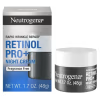
Non-drying formula: Neutrogena Rapid Wrinkle Repair Cream Retinol Pro+

- Affordable for retinol
- Has hydrating ingredients
- Some need stronger formula
Key ingredients: Retinol, hyaluronic acid and micropeptide | Size: 1.7 oz. | Type: Cream
Emma Stessman, a writer at Shop TODAY, recommends this retinol cream that she's been using "every few nights for the last few months." She says that she has "noticed a big difference in my skin!"
Stessman continues, "It definitely helps with uneven texture and fine lines. It’s also more moisturizing than other retinol formulas I’ve tried so it doesn’t dry out my skin as much."
A "game changer": Paula's Choice Total Repair Serum

- Moisturizing ingredients
- No fragrance
- Serum oxidates
Key ingredients: Retinyl propionate, niacinamide and hexylresorcinol | Size: 1 oz. | Type: Serum
Shannon Garlin, an associate editor at Shop TODAY, recommends this retinol serum by Paula's Choice. She says, "My journey with retinols has been tricky sense my skin is really dry and sensitive. Even when I use it just once a week, I will wake up with red skin."
However, Garlin continues, "This Paula’s Choice option has been a game changer, it contains the brand’s own 'retinyl' complex along with niacinamide and glycerin, which leaves my skin feeling refreshed, firm and hydrated. I use it once or twice a week for over a year and haven’t had a reaction yet!"
The "perfect" starter retinol: S'able Labs Okra Face Serum

- Very gentle
- Great for sensitive skin
- Smell may be strong
Key ingredients: Hydroxypinacolone retinoate (a type of retinoid) and myoxinol | Size: 1 oz. | Type: Serum
Kamari Stewart, and associate editor at Shop TODAY, recommends this face serum. She says, "I went to the launch event for this product and the founder, Sabrina Elba, was explaining all about how her products are A-beauty based (aka ingredients are derived from Africa!)."
Stewart continues, "I was very intrigued about this retinol that she says is super gentle but was hesitant since I haven’t had the best experience with retinol in the past. I’ve been trying it a few times a week for the past month or so and can honestly say this is super gentle. I think it’s a perfect starter retinol for anyone who has had a bad experience or has just never used it before."
What is the best retinol for beginners?
It depends. Our experts agree on starting with a retinol product with a lower concentration of retinol. As far as retinol concentrations go, you will find those with between .1% and .3% (give or take) to be suitable for beginners or those with sensitive skin.
Jaliman advises new retinol users start with encapsulated retinol as it is a milder form and delivery happens gradually.
Malik adds, “Combinations with buffering ingredients like niacinamide or ceramides can help achieve better tolerability even for sensitive skin types, and beginners.”
How to help ease retinol irritation
If you experience retinol irritation (although we hope this doesn’t happen), Jaliman recommends switching to a product with a lower concentration of retinol and/or using the product less frequently.
A good rule of thumb is to use your new product once or twice a week and gradually increase the number of days per week you’ll use it as you find your skin can tolerate it.
That said, it is important to engage in the proper preventative measures to help prevent irritation at the outset.
Gabriela Soza, a board-certified dermatologist, notes that there’s no need to rush into using retinol and that using small amounts or lower concentrations at first can help build tolerance and prevent irritation.
Frequently asked questions
Although many people with sensitive skin can typically tolerate retinol, Malik notes that those with rosacea and/or eczema (especially when experiencing flare-ups) should avoid retinol products.
Additionally, he notes that retinol should not be used by individuals who are actively pregnant. With this in mind, it is important to ask your doctor about any potential interactions that retinol may have with medications you take. “Those on medications causing photosensitivity or undergoing certain treatments should seek medical advice before incorporating retinol,” explains Kilgour.
When it comes to the type of retinol product that is better for the skin (especially sensitive skin), this will depend on your skin care goals.
If you want to hydrate your skin, Malik says that cream-based options may be more suitable, whereas if you want to really target a certain area, serums are usually more potent and better able to do so.
There are several areas where retinol should not be applied to keep your skin healthy and protected. Some of the most common areas our experts note patients should skip when applying retinol-based products include the lips, nostrils and mouth area. Additionally, Yadav recommends not placing retinol near the eyes as it could lead to dry eyes.
Although retinol can be placed on the chest and neck areas, Sean Alemi, a New York-based, double board-certified facial plastic and reconstructive surgeon, notes that these areas tend to be extra sensitive and therefore should be more carefully monitored during the application process.
That said, it is always a best practice to speak with your physician and/or do a patch test before applying retinol to any area as a protective measure. And, do your best to avoid applying retinol to any areas with broken skin.
How we chose the best retinol for sensitive skin
To compile our list of the best retinol for sensitive skin, Shop TODAY rounded up the recommendations offered by the board-certified dermatologists we interviewed. We also listed a couple of picks recommended by some of our editors at Shop TODAY.
Meet the experts
- Debra Jaliman, MD, is a board-certified dermatologist in New York City and the author of “Skin Rules” (St. Martin’s Press).
- Kunal Malik, MD, is a board-certified cosmetic dermatologist and assistant professor at Icahn School of Medicine at Mount Sinai in New York.
- James Kilgour, MD, is the founder of KilgourMD and Stanford University Resident Dermatologist.
- Gabriela Soza, MD, FAAD, is a board-certified dermatologist at PFRANKMD by Dr. Paul Jarrod Frank.
- Geeta Yadav, MD, is a board-certified dermatologist and founder of FACET Dermatology.
- Sean Alemi, MD, FACS, is a double board-certified facial plastic and reconstructive surgeon in New York.


